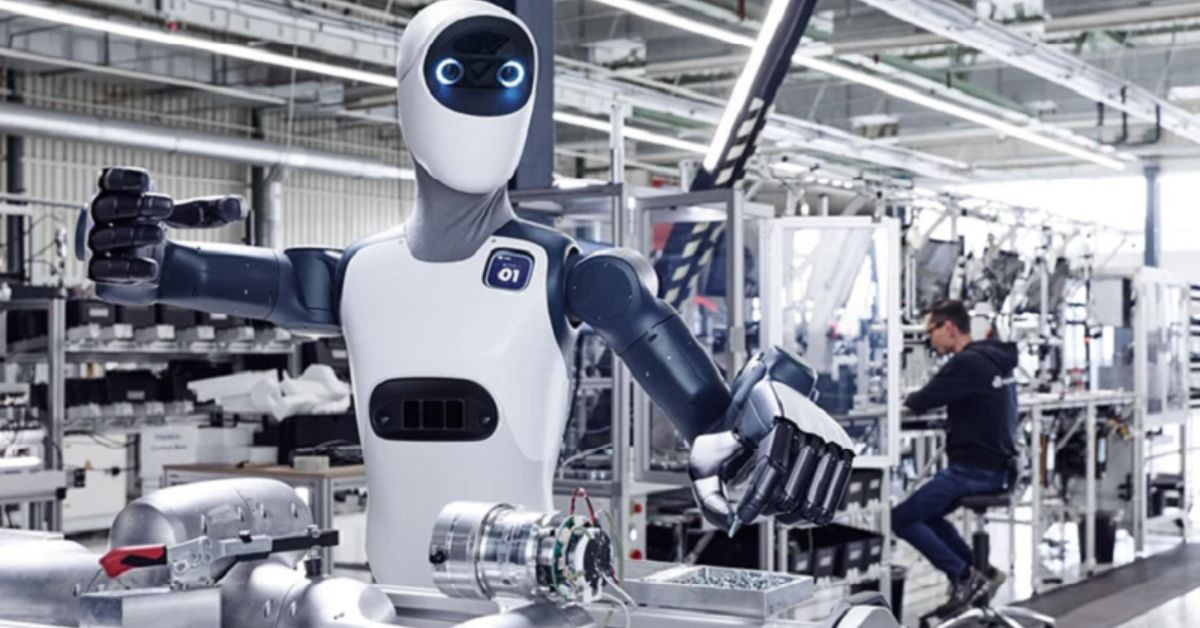
Humanoid is preparing to deploy humanoid robots at factories operated by German industrial supplier Schaeffler. The agreement signals a major step toward bringing physical AI systems into large-scale manufacturing environments.
According to reports, the partnership could involve between 1,000 and 2,000 humanoid robots across Schaeffler’s global facilities by 2032. The companies have not revealed the financial details of the deal.
The first deployment phase is expected between December 2026 and June 2027 at two Schaeffler sites in Germany. Initial tasks will focus on box handling and large-scale production testing.
Humanoid CEO Artem Sokolov said the rollout will begin in Herzogenaurach and Schweinfurt. The robots will also be integrated into existing factory systems and workflows.
Humanoid Robots Begin Entering Factory Operations
Schaeffler is testing humanoid robots for physical production and warehouse tasks. The company aims to automate repetitive material handling processes while evaluating how robots perform in active industrial environments.
Under the agreement, Schaeffler will become Humanoid’s preferred supplier for joint actuators through 2031. The partnership is expected to support more than half of Humanoid’s actuator demand.
The deal could involve at least one million actuators for wheeled humanoid platforms. This highlights the growing scale of investment in industrial robotics and physical AI infrastructure.
The deployment reflects a broader shift toward AI-powered factory automation. Manufacturers are increasingly testing humanoid systems to improve productivity and reduce labor-intensive manual tasks.
AI Companies Train Robots Using Human Motion Data
The Schaeffler project comes as other companies expand physical AI testing programs. South Korean startup RLWRLD is gathering human movement data from hotels, warehouses, and retail environments.
At Lotte Hotel Seoul, workers are recorded while preparing banquet tables and organizing service items. Cameras attached to workers capture hand movements, grip patterns, and body positioning.
RLWRLD is also collecting data from logistics employees at CJ Logistics and retail workers at Lawson. The company uses this information to train robots for real-world industrial and service tasks.
Engineers convert human actions into machine-readable data using motion tracking systems, VR headsets, and specialized gloves. The goal is to improve robot dexterity and task execution.
Major Companies Accelerate Physical AI Investments
Physical AI deployment is gaining support from major industrial companies across Asia. RLWRLD predicts industrial humanoid robots could begin operating at scale by 2028.
Hyundai Motor Company plans to introduce humanoid robots built by Boston Dynamics at its global factories, beginning with its Georgia facility in 2028.
Meanwhile, Samsung Electronics aims to convert all manufacturing sites into AI-driven factories by 2030. Its plans include both humanoid and specialized task-focused robots.
These developments show how physical AI is moving beyond research labs and into real industrial operations. Companies are positioning humanoid robotics as a key part of future manufacturing strategies.
Read : AI as a Teammate Helps Build New Workplace Skills
Labor Concerns Grow Alongside Robot Adoption
As humanoid robots move closer to large-scale deployment, labor groups are raising concerns about workforce impacts and worker data collection practices.
The Korean Confederation of Trade Unions has warned that increased automation could affect employment opportunities and reduce demand for skilled human workers.
Union representatives argue that governments and employers should work more closely with employees when implementing AI systems. They emphasize that many forms of skilled labor remain deeply human-driven.
Hospitality companies are also exploring robotics for cleaning and support tasks. While current humanoid robots remain slower than human workers, businesses expect future systems to handle more operational duties over time.
Industry experts believe robots may eventually take over portions of back-of-house work, though customer-facing roles requiring empathy and direct interaction are expected to remain difficult to automate fully.